
The plan was to pull at your heartstrings. To open with a tear-jerking narrative of a victim-survivor. To grab you with clickbait. I asked my mother, a legal professional- she knew someone. I asked my partner, a graphic designer- he knew someone. I asked my former colleagues- journalists- they knew someone. You probably know someone too. Many of us have unknowingly encountered a dark reality – the exchange of basic services for sexual favours. However, the stories of these victims remain buried under layers of fear and shame. According to a report by the Centre for Equality and Justice on sexual bribery in the health and justice sectors in Sri Lanka (2023), social, political and economic realities that intersect further aggravate the negative effects of sexual bribery.
Sexual bribery, in this context, is like a disease that everyone knows is widespread, but no one can see. The recent Anti-Corruption Act No. 9 of 2023 in Sri Lanka sparked conversation by expressly acknowledging that sexual bribery is a form of bribery that can and does take place in Sri Lanka. However, it fell short in its execution, using the term ‘sexual favour’ instead of a more stronger and accurate word. This begs the question – do the new reforms seek to alleviate the stigma surrounding sexual bribery and provide avenues for redress? Or do they, intentionality aside, accentuate existing prejudices against sexual bribery victim-survivors and reinforce toxic power structures?
The recent Anti-Corruption Act criminalizes both giving and receiving a ‘bribe’ in the public and private sectors; so what exactly is bribery? According to the Act, bribery is “the offer, solicitation, or acceptance of any gratification” subject to the contraventions stated. According to the United Nations Convention Against Corruption, bribery is “the promise, offering or giving, to a public official, directly or indirectly, of an undue advantage, for the official himself or herself or another person or entity, so that the official act or refrain from acting in the exercise of his or her official duties” (Article 15). Article 21 of this treaty further criminalizes giving and accepting bribes in the private sector.
A term used under Sri Lankan law that does not appear in the UN convention caught my attention, and I decided to search for the meaning of that word: gratification. According to the Cambridge Dictionary, gratification denotes “pleasure or satisfaction”. As this recent Anti-Corruption law also states that ‘gratification’ includes ‘sexual favours’, I decided to look up the word ‘favours’. Again, according to the Cambridge Dictionary, a favour is “an advantage that you give to someone, such as money or a good job, especially when this is unfair”, and the example given was about politicians giving ‘favours’ to civilians. With this simple search, it was apparent that the word ‘favour’ places the blame or the focus of the bribe on the giver, not the taker.
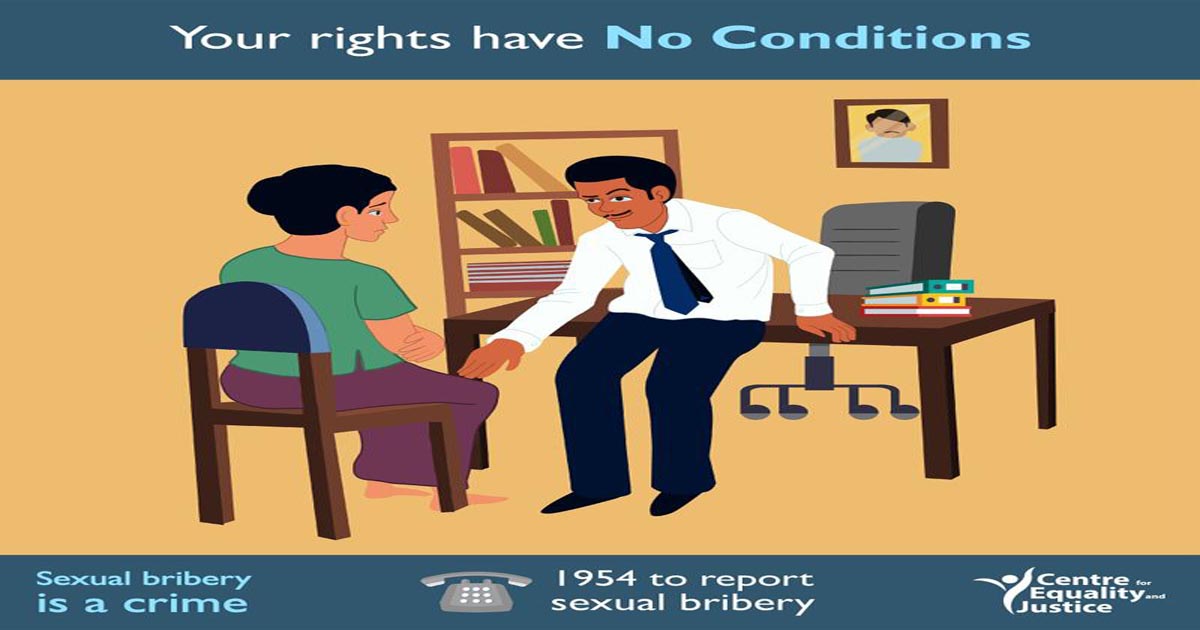
Why does this matter? Why is the word ‘favour’ problematic? Because it implies the giver is the primary actor. In the context of this law, ‘sexual favour’ focuses on the person whose rights were violated and underpins a victim-blaming mentality. Let’s use a hypothetical scenario to visualise this. Imagine that you go to an official to receive a service that they are officially obligated to provide. This official makes sexual advances towards you and states that they will only provide the services if you comply with those advances. This should be viewed as a clear-cut abuse of power – the official has failed in their duty and committed a crime. But the wording in the Anti-Corruption Act blurs the line and leaves room to blame the victim-survivor.
The wording of the Anti-Corruption Act becomes crucial in this context, because, despite what actually happened, it redefines and reduces the incident from a rather prejudiced perspective. Further, it fails to acknowledge the power imbalance between the two parties involved. Research by the Centre for Equality and Justice on military widows’ experience with sexual bribery in Sri Lanka (2018) showed that widowed women and single women are often considered vulnerable by sexual predators. The briefing paper also states that vulnerability “is further exacerbated in contexts of power inequality such as when economically deprived widows and single women seek services from state and military institutions”.
Recognition of the power dynamics between the parties involved in a sexual bribery incident, clear issues with the team ‘sexual favour’, and the stigmatizing impact of this crime point to the need for policy reforms that embrace a more nuanced and comprehensive understanding of sexual bribery offences. In this respect, rephrasing ‘gratification’, and ‘sexual favours’ in the Anti-Corruption Act is essential. Including sexual bribery in the legislation is a positive step; however, it does not sustainably or comprehensively address the culture of victim-blaming and the patriarchal and misogynist systems that reinforce it.
In the opening of this article, I discussed the silence and stigma that surround sexual bribery in Sri Lankan society. The current interpretation of sexual bribery as per the Anti-Corruption Act only contributes to sustaining that silence rather than helping victim-survivors tell their story and seek support. The legislation is considered a tool through which justice is served, but if the very tool one relies on is prejudiced, where else can a victim-survivor go? How can a victim-survivor overcome the prevailing culture of shame and stigma? These questions will remain unanswered until there is a stronger understanding of sexual bribery among lawmakers and policymakers.
To report an instance of sexual bribery to the Commission to Investigate Allegations of Bribery or Corruption, call 1954 or email [email protected].