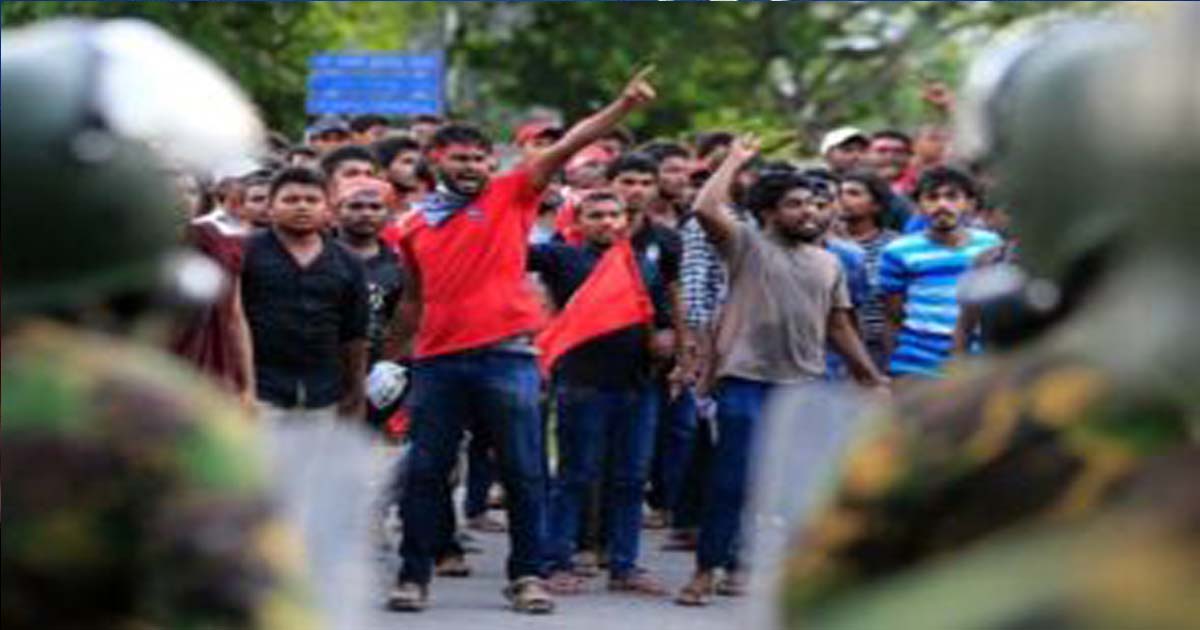
The European Union (EU) has raised fears of a risk of repressive action by the Sri Lankan Government, as seen in the disproportionate use of force against civil protestors.
In this challenging context, the EU says it is paramount that the State shows restraint and continues to guarantee freedom of association, freedom of expression and the right to protest free from intimidation.
The EU said that the process of reform will be more sustainable and robust if Sri Lankan civil society is part of it and if the approach is truly inclusive.
The EU expressed these views in a joint report to the European Parliament and the Council
on the Generalised Scheme of Preferences covering the period 2020-2022.
The EU conducted a monitoring mission to Sri Lanka from 24 September to 5 October
2021, the first GSP+ beneficiary to be visited after the onset of the COVID-19 pandemic.
The mission was essential to assess the human rights situation, with some focus on the Prevention of Terrorism Act, and the labour rights situation.
On 28 October 2022, the sixth meeting of the EU-Sri Lanka Working Group on Governance, Rule of Law and Human Rights took place in Colombo and addressed matters of GSP+ monitoring in the areas of human and labour rights.
The Working Group was preceded by meetings between the delegation from the EU and Sri Lankan State institutions and civil society.
“Sri Lanka has taken significant steps towards the protection of human rights since its
readmission into the GSP+ scheme in 2017. However, challenges remain and a risk of backtracking on reforms was identified in the years between 2020 and 2022. In March 2022, popular discontent translated into a mass movement, overcoming ethnic, class, gender, and generational divides. The protests highlighted that Sri Lanka’s civil society is organised and capable of mobilisation, and for a significant period they were able to protest in the spirit of democracy and freedom of expression and assembly. While this points to some deeply felt grievances, during the period of the protests Sri Lankan citizens across communities could enjoy space for dissent,” the EU said.
The EU said that the first half of 2023 has seen efforts by the President to establish a Truth and Reconciliation Commission as a reconciliation mechanism based on accountability. Progress through the establishment of a functioning secretariat is underway, but some stakeholders have raised questions about the Commission’s effectiveness and independence.
Sri Lanka initially benefited from the GSP+ scheme until its access was temporarily withdrawn in 2010 due to significant shortcomings in the country’s implementation of three UN human rights conventions.
Following a change of Government in 2015, the country embarked on major reforms aimed at achieving national reconciliation, and respect for human rights, the rule of law and good governance, as well as sustainable economic development. The new administration re-engaged with the international community, including the UN system, and instituted
improvements in fundamental freedoms.
Sri Lanka reapplied for GSP+ in July 2016 and was readmitted to the scheme as of 19 May 2017.
The EU said that overall, Sri Lanka has made progress in implementing the commitments that led to its readmission to GSP+ in 2017, but challenges remain and Sri Lanka should avoid the risk of backtracking on fundamental rights.
(Source: Colombo Gazette)