
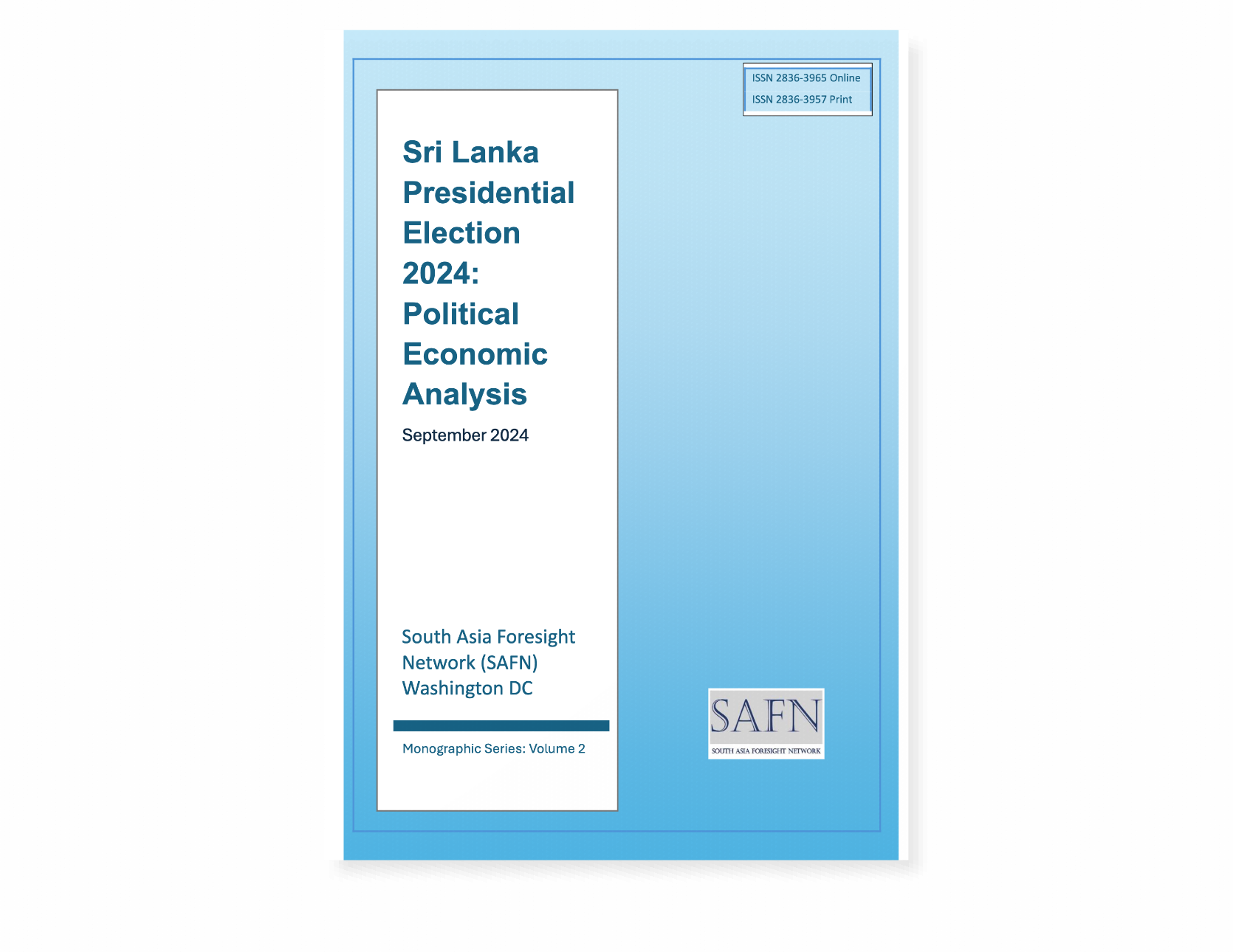
Washington, DC – The South Asia Foresight Network (SAFN) has released a significant report, titled Sri Lanka Presidential Election 2024: Political and Economic Analysis, issuing a critical warning to the country’s policymakers and political leaders. As Sri Lanka nears its pivotal presidential election on September 21, 2024, the report details pressing findings and offers urgent recommendations to address the escalating political, economic, and social risks confronting the nation.
The report is based on Key Informant Interviews (KIIs) with influential academics, journalists, politicians, civil society leaders, and diplomats, employing qualitative research methodologies to forecast potential scenarios for Sri Lanka’s political and economic future.
Key Findings:
- Democratic Contraction: Despite changes in leadership, the report reveals an alarming erosion of democratic freedoms. Legislative measures such as the Prevention of Terrorism Act and the Online Safety Act are highlighted as examples of the state tightening its control over civil liberties, with military and police forces regularly deployed to quash political dissent. This decline in democratic space poses a severe long-term threat to Sri Lanka’s democratic institutions.
- Governance Challenges: While institutional frameworks exist, public trust in governance has been undermined by corruption and inefficiencies. The report underscores the urgent need for reforms in anti-corruption mechanisms, judicial processes, law enforcement, and policy-making transparency.
- Economic Instability: Ongoing economic instability continues to erode public confidence. While the government claims early signs of recovery, rampant corruption and a lack of transparency undermine institutional integrity. Persistent issues such as inflation, unemployment, and socioeconomic inequality aggravate public dissatisfaction.
- Political Alternatives: The Samagi Jana Balawegaya (SJB) stands out as the most credible political alternative. The report commends the SJB’s experienced leadership and its success in building coalitions, noting that these factors position the party to effectively execute a coherent and comprehensive economic reform agenda. By uniting around a clear vision for economic stability and governance reform, the SJB is presented as the strongest force to lead the nation forward. In contrast, while the National People’s Power (NPP) gains momentum from its anti-corruption stance and the Aragalaya movement, the report notes its lack of governance experience, a crucial factor in addressing Sri Lanka’s economic crisis.
- Foreign Relations and Policy: The report emphasizes the importance of a balanced foreign policy as Sri Lanka navigates its relationships with India, China, and the United States. Sustainable economic recovery and political stability will depend on pragmatic and clear foreign policy strategies.
Urgent Warning to Policymakers:
The SAFN report cautions that without swift reforms, Sri Lanka risks descending into a “polycrisis”—a convergence of economic, political, and social challenges. The nation’s leadership must act promptly to halt democratic backsliding, stabilize the economy, and promote political accountability. External assessments, including the IMF Governance Diagnostic and the UN OHCHR report 2024, further underscore the reforms required to protect institutional integrity and uphold human rights.